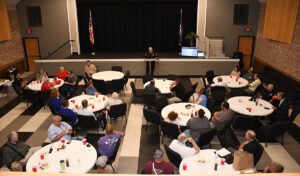

The Northeast Louisiana Firefighters Association (NLFA) held its monthly meeting Tuesday night, Aug. 18, at the Historic Strand Theater in Jena, hosted by LaSalle Parish fire departments, with state fire officials touting recent reforms to training costs and the keynote speaker leading a candid discussion on the recruitment and retention crisis facing departments across the region.
NLFA is a 16-parish organization representing firefighters and fire departments across northeast Louisiana, of which LaSalle and Catahoula parishes are members.
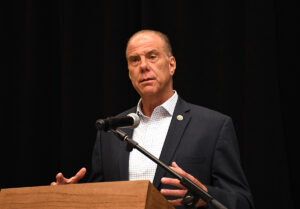
Whitehall Volunteer Fire Department Chief and NLFA Secretary/ Treasurer Jim Justiss opened the meeting by recognizing sponsors and vendors before introducing the new Department of Public Safety Principal Assistant Bryan Adams, who recently stepped down as State Fire Marshal to take on the broader role within the department at the request of Gov. Jeff Landry.
Free training, new leadership at State Fire Marshal’s Office
Adams told the group he has worked to expand free training access for firefighters statewide since taking on the fire marshal position roughly two and a half years ago.
“I promised to deliver cost effective training to you all, the volunteers, who’s the heart, my heart of where I came from,” Adams said. “We did that and are continually looking for ways to better serve all of our departments.”
Adams announced that certification classes, instructors and testing are now fully free for firefighters across the state, with candidates given three opportunities to pass each certification test.
Adams also addressed the broader recruitment challenges facing volunteer departments nationwide, describing a shrinking interest among younger generations in long term volunteer commitment.
“We got to find a way. We’re going to find a way to spark that and make sure that we get kids interested,” Adams said. “We can’t have a paid fire department all across the state. It’s just not going to happen. It’s not feasible. It’s not financially fundable.”
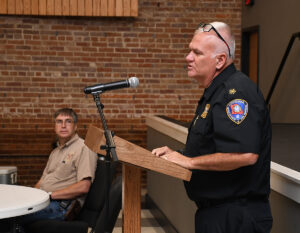
Adams then introduced Louisiana’s new State Fire Marshal, Chad P. Sonnier, who was appointed to the role after Adams took on expanded duties within the Department of Public Safety.
Sonnier, who spent 37 years with the Lafayette Fire Department before serving as Lafayette Parish’s Office of Homeland Security and Emergency Preparedness director, told the group his background gives him a direct understanding of the challenges volunteer departments face.
“My heart is obviously with the volunteer fire department, because that’s where I dug my teeth into it,” Sonnier said.
Sonnier credited Adams with turning around the State Fire Marshal’s Office financially, noting the office faced a $7.5 million deficit when Adams took over in 2024 and now holds an $8 million surplus.
“With that $8 million, it could have been blown just as easy as we made it,” Sonnier said. “But what he did is he invested back into the fire service.”
Sonnier said those investments have included renovated offices, new vehicles, higher pay for fire marshal employees, and dramatically faster building plan reviews and inspections.
“Plans in review, when he took over, there was a six-to-eight-week plan in review,” Sonnier said. “Now, today, it’s a 10-to-14-day process.”
Sonnier also announced a new $5 million burn building and training dormitory project expected to be placed into service by fall, with full completion by July 2027.
“So, if you want to come take a free class, you’ll be staying in free dorms, some brand new dorms as well,” Sonnier said.
RAPIDES CHIEF LEADS DISCUSSION ON RECRUITMENT AND PUBLIC PERCEPTION
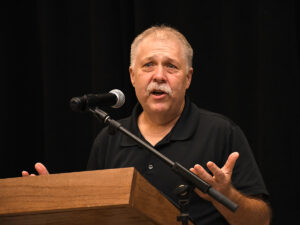
Following remarks from the state officials, Justiss introduced retired Rapides Parish Fire Chief Joe Hamner for the evening’s scheduled keynote speaker where he spoke on the challenges facing all fire departments, specifically volunteer departments.
Hamner opened by offering condolences for the recent death of Olla Fire Chief Kim Taylor, recalling that Taylor had attended some of the first and most recent classes Hamner ever taught.
Hamner then led an open discussion with attendees on the state of the fire service, identifying recruitment, retention and an aging volunteer force among the industry’s biggest challenges.
“The average age of a firefighter is between 30 and 49 years of age in the United States,” Hamner said, citing National Fire Protection Association data. “Firefighters under the age of 30 is only 22% of all firefighters.”
Hamner said the gap in interest among younger recruits is compounded by rising training requirements, financial strain on volunteers, and competition from other demands on people’s time.
“It’s hard enough to recruit to get somebody to come in and volunteer their time, but now you’re adding all these training requirements,” Hamner said. “Not only are we requiring them to do this training, a lot of times they got to foot their own bill.”
Hamner also addressed what he described as a widening gap between public perception of firefighters’ work and the reality of the job.
“The public expects the fire department to be an all-hazard safety net responding agency with complete professionalism and without delay, 24/7, 365, in all weather,” Hamner said. “Notice nowhere in there it said emergency.”
Hamner said the vast majority of calls departments respond to are lower risk, high volume incidents rather than the large-scale emergencies that draw public attention and support.
“The reality is, most of our calls are the low risk, high volume type calls that wear people out,” Hamner said. “That’s where you start seeing our people kind of backing off a little bit.”
Hamner encouraged departments to be more proactive in communicating their day-to-day work to the public, including inviting community members and elected officials to see firsthand what firefighters do.
“We control it,” Hamner said. “We do good at the big stuff, not so much at the little things. Let the public know what’s going on.”
LOCAL DEPARTMENTS PRAISED FOR COOPERATION, EXPANDING ROLE
Hamner closed by praising the cooperation between paid and volunteer departments across LaSalle Parish, saying that kind of collaboration is essential to the future of the fire service.
“How well the departments get along here and work together, that’s huge,” Hamner said. “I cannot stress that enough.”
Justiss closed the program by reflecting on how the role of local fire departments has expanded well beyond fighting fires, including a growing number of medical calls now handled by firefighters trained as EMTs and EMRs.
“We’re going on more medical calls probably than we ever have,” Justiss said. “Kudos to you guys that have stepped up and become EMRs and EMTs. They were really needed, and it’s expanded the services here.”
The meeting concluded with a raffle drawing for door prizes among attendees, provided by various sponsors.