
Affects LaSalle, Caldwell & Richland Parish
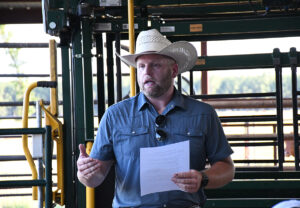
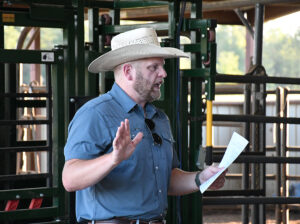
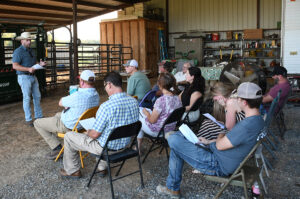
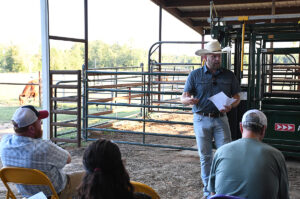
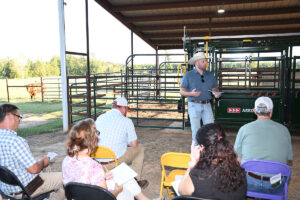
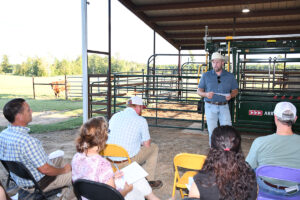
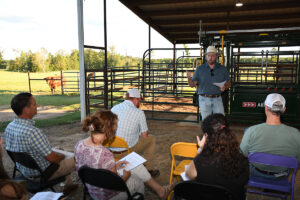
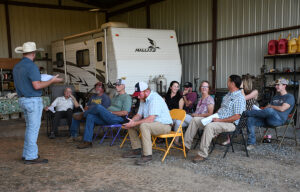
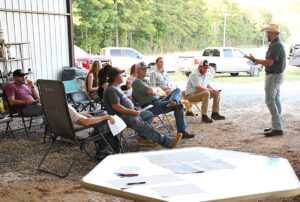
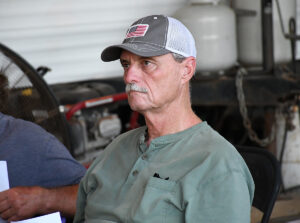
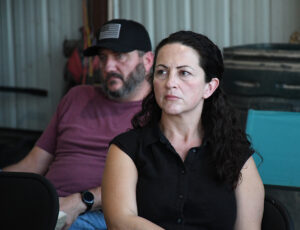
A group of 10 landowners gathered Thursday night, Aug. 27, at a private property facility in LaSalle Parish to form a new coalition opposing Entergy’s proposed Project Omega 500kV transmission line, a project many say threatens to cut through family farms, homesteads and land passed down through generations.
The group, initially conceived as the LaSalle Landowners Coalition, was renamed the Louisiana Landowners Coalition during the meeting, with organizers planning to recruit members along the transmission line’s entire proposed route, stretching from south Louisiana on a northeasterly path through Avoyelles, Rapides, LaSalle, Caldwell and Richland parishes to the new Meta data center under construction near Rayville.
Although only ten people were at the impromptu meeting, another ten or so from LaSalle Parish would have been there if not for scheduling conflicts, organizers said, providing names to back up their membership.
LANDOWNERS DESCRIBE IMPACT ON THEIR LAND
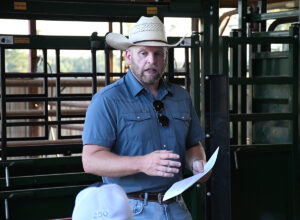
Dustin McCann, who organized the meeting after learning just three weeks ago that Entergy had already surveyed some neighboring properties back in June, said the discovery left him frustrated with how little communication landowners had received.
“They surveyed other people’s land around here in June, and I didn’t find out about it until August, three weeks ago, this past Tuesday,” McCann said. “I feel like somebody just put two dots on a map, and drew a straight line between it, and whoever was on the line, well, sorry about you.”
McCann, whose 63-acre property lies in the projected path, said the land means more to his family than any offer could replace.
“It’s our home. It’s our work. It’s where we hunt. It’s where we raise our kids. It’s where we farm. It’s where we live, and I don’t want it,” McCann said, speaking of Entergy’s transmission line.
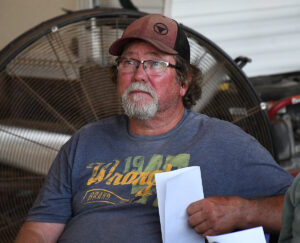
Several landowners described how the proposed 250 foot wide right of way would compound damage already caused by existing pipeline easements on their property. Glenn Ashworth, speaking on behalf of a neighboring family, said the new line would leave little usable land on a 100acre tract that already carries a decades old pipeline easement.
“It’s going to pretty much eliminate that 100 acres,” Ashworth said. “There’s no land left.”
Landowner Linda Weeks said she discovered a survey stake near her barn after declining to sign a survey waiver, raising concern about how close the proposed line could come to her home.
“We don’t know for sure, but potentially 250 feet from where that stake is, it’s right on top of us,” Weeks said.
Aubrey McCann, who said she and her husband Dustin built their cattle farm by hand from raw pine timber, said she was disheartened at the idea of having to hire legal help to protect land she already owns outright.
“Everything that we have here, we built with our own hands, and we did that so that we could be away from the fray,” she said. “I am very annoyed that I would have to get a lawyer to defend land that I already own.”
FRUSTRATION WITH ELECTED OFFICIALS AND NDAS
When asked what they might say if given the chance to speak directly with the governor, their state representatives, senator or Public Service Commissioners, several landowners expressed a shared sense that officials don’t fully grasp what’s at stake for families along the route.
“Let’s find your land and run it across your land and see how you feel about it,” Ashworth said. “This is a big deal to us, but for them, it’s money in their pocket. They’ll do whatever, but when it affects them, it’s a different story. It’s rules for thee and not for me! “
Landowners also voiced concern over the use of non-disclosure agreements by public officials connected to the Meta data center project and Entergy’s role in powering it. McCann said he has learned that roughly 300 such agreements have been signed over the past two years by officials ranging from the congress to the governor’s office down to state representatives.
“I don’t think that any person that we elect to a position should have the option to not disclose any details of decision making when they’re elected officials that we’ve voted into those roles,” Aubrey McCann added, visibly aggravated by the number of NDAs that have been signed.
The LaSalle residents said that because many of the “big corporation” deals have NDAs signed by government officials, it has led to projects like Entergy’s proposed line draped in secrecy – leaving the public unaware until it is too late for action to stop a project that may jeopardize their way of life.
Along with the NDAs, the group also cited the state’s newly passed legislation to speed up economic development projects as further evidence Louisiana has crossed a line.
McCann said the state’s so-called “Lightning Directive,” which compresses the traditional eminent domain review timeline, has made it difficult for landowners to fully understand or respond to a project.
“With this lightning directive, with everything being sped up, and it’s such a truncated timeline, it makes you wonder, is Entergy doing their due diligence in route planning, or are they just sticking two points on a map, drawing a line between it, and building a line that is cheapest and easiest for them,” McCann said.
GROUP OUTLINES STRATEGY, NEXT STEPS
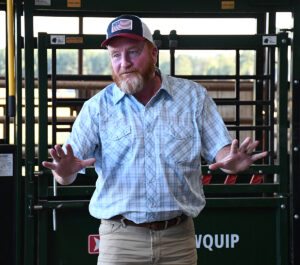
Gary Musgrove, president of Save My Louisiana, a group formed to oppose carbon capture and pipeline projects elsewhere in the state, traveled from Woodworth to share guidance with the new coalition based on his own group’s experience.
“Grassroots organizations are not easy. It’s not easy,” Musgrove said. “This is going to be a long, hard fight and those big groups are going to come after you. You have to be willing to stick with it.”
Musgrove said his organization spent roughly $50,000 of its members’ own money to challenge the constitutionality of eminent domain statutes tied to carbon capture projects, a case still awaiting a November hearing, and encouraged the new coalition to consider similar legal options as it moves forward.
“Is it public purpose? Well, you’re going to have to file a lawsuit against that to determine it,” Musgrove said.
Despite the challenges ahead, Musgrove encouraged the group to stay engaged, pointing to his own organization’s success slowing or stopping several carbon capture projects across the state over the past year.
“In the beginning it was just seven of us, but with a coalition of like-minded individuals and other groups and a following, I think we have made a difference,” Musgrove said.
By the end of the meeting, the coalition agreed to two key commitments: declining to sign any easement papers, survey waivers or right of way offers from Entergy without first consulting the group and directing any Entergy representatives who make contact back to the coalition.
“Please do not sign any easement papers or any offers from Entergy until we’ve talked as a group,” McCann said, and attendees agreed.
The coalition released a formal statement calling on the Louisiana Public Service Commission to protect landowners’ property rights as the project moves forward.
“Every landowner in Louisiana understands the value of what they’ve built, whether it’s a family home, an active farm or hunting lease passed down through generations,” the statement read. “We are deeply concerned that the accelerated timeline under the Lightning Directive will compress necessary reviews and harm the property rights of the people of our state by rushing projects through before alternatives can be properly evaluated. We want to be proactive in working with Entergy to ensure they deal directly with us, communicate openly and evaluate alternative routes that favor private property and improved pasture. Above all, we expect the Public Service Commission to defend and respect the basic property rights of the voters who elected them.”
The group also formally petitioned the Public Service Commission, asking that Entergy be required to co-locate the transmission line along existing utility corridors and commercial timberland rather than routing it through working farms and residential properties.
“Petitioners aver that the currently proposed route lacks discretion and frequently bisects properties by cutting directly through the center of working lands, homesteads and agricultural operations,” the petition states. “This unnecessary bisection represents an excessive burden on private property rights that could be avoided.”
McCann said Entergy had not returned his calls after three weeks, though the company is reportedly expected to begin sending formal offer letters to affected landowners as early as next month. He said the coalition plans to attend the Louisiana Public Service Commission’s Sept. 16 meeting in Baton Rouge, with additional meetings expected as more landowners along the route are identified.
Plans are to have Louisiana Landowners Coalition incorporated as a non-profit, begin a social media campaign to fight Entergy’s transmission line project, and do all they can to have more Louisianans join their effort to stop what they call “extreme land grabs” through use of government and big corporation overreach.
McCann said he hopes that Entergy will see the error of this project’s route and choose to reroute their line. He said he really wants to work with Entergy to come to a solution everyone can agree upon.
Although there was not much optimism that Entergy would change their mind so easily, all agreed that their personal rights as landowners were being unconstitutionally trampled and vowed to fight to the bitter end for the sake of their families and lives.
“We don’t want it on our land. We don’t want any part of it. That’s how I feel. I don’t want any part of it. I don’t want it out here,” he emphatically proclaimed. “There’s not an amount of money that would satisfy me – we’d rather just die on our land, but I know everybody’s different, and that’s totally okay. The deal is, is that we’re in on it together, where we don’t want it on our land, especially with the way they’re doing it.”
To join the Louisiana Landowners Coalition, contact McCann at (318) 202-9094.
(Entergy was contacted in preparation for this story but refused to comment on any legal issues, specifically if the company will use the legal process of eminent domain to acquire the private property land rights-of-way. They did, however, confirm the transmission line project. The survey company employed by Entergy was also contacted but did not respond.)